Most people are told at some point that they need wisdom tooth removal. It has become such a routine piece of advice that patients arrive at our clinic assuming the decision has already been made. Often it has not. A wisdom tooth that has come through straight, bites properly and stays clean can sit in your mouth for the rest of your life without causing a single problem.
What decides it is not whether you have wisdom teeth, but whether yours are damaging something or about to. This article sets out both sides, including the situations where leaving the tooth alone is the better call.
- When Wisdom Tooth Removal Is Actually Needed
- 7 Signs the Tooth Should Come Out
- 5 Signs You Can Keep It
- What Impacted Really Means
- How Your Dentist Decides
- What Happens If You Wait
- Signs That Need an Appointment This Week
- The Procedure, Recovery and Cost in Kolkata
- Four Myths Worth Correcting
- Frequently Asked Questions
When Wisdom Tooth Removal Is Actually Needed
A wisdom tooth should be removed when it is causing disease, or when an X-ray shows disease is coming. It can usually stay when it is fully erupted, correctly positioned, and you can clean around it.
That is not a soft opinion. The UK's National Institute for Health and Care Excellence reviewed this question and advised against removing healthy, symptom-free wisdom teeth as a precaution. You can read the NICE guidance on wisdom tooth extraction in full. A 2020 Cochrane review reached a more cautious conclusion: there is not enough evidence to say confidently whether buried, trouble-free wisdom teeth are better out or left in.
What both agree on is that surgery carries small risks of its own, so a tooth doing no harm does not automatically need removing. The argument on the other side, made by several oral surgeons, is that decay on the back surface of the second molar is usually caught late and that tooth is much harder to replace. This is why the X-ray matters more than your age or your family history.
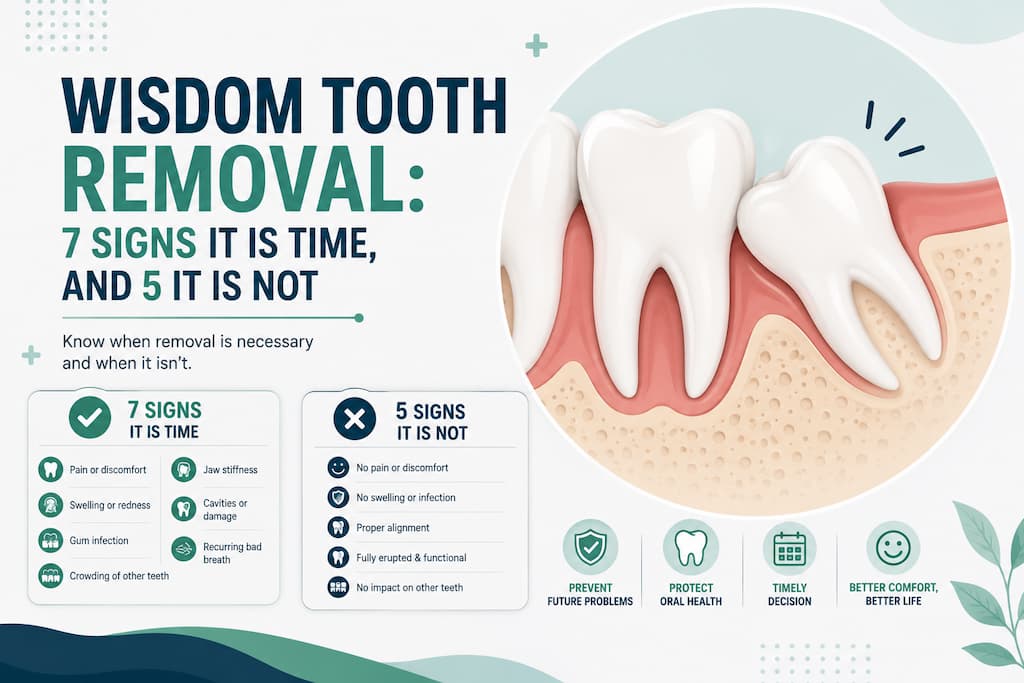
7 Signs the Tooth Should Come Out
If any of the following describes your situation, book an examination rather than waiting for it to settle by itself.
1. Swelling around the gum that keeps returning
A partly erupted wisdom tooth leaves a flap of gum lying over it. Food and bacteria collect underneath, and the gum becomes infected. This is called pericoronitis. It clears with antibiotics and cleaning, then returns a few months later, then returns again. Each round does a little more damage to the bone.
2. Decay you cannot fill
Wisdom teeth sit at the very back of the arch. When decay starts there, placing a filling is often impractical because the dentist cannot reach or isolate the surface properly. Removal becomes the more predictable option.
3. It is damaging the tooth in front
This is the one that does harm quietly. A wisdom tooth lying at an angle presses into the second molar. Food packs into the gap between them, decay starts on a surface no toothbrush reaches, and by the time it is found the second molar may need treatment too. Losing a healthy second molar to a wisdom tooth is the outcome we work hardest to prevent.
4. A cyst on the X-ray
An unerupted tooth can develop a fluid-filled sac around its crown. It is painless and slowly hollows out the jawbone. This is uncommon, but it is invisible without imaging, which is the argument for an X-ray even when nothing hurts.
5. Pain at the back of the jaw that will not settle
Particularly when it arrives with a bad taste, or you cannot open your mouth as wide as usual.
6. Gum disease around the tooth that keeps coming back
If the pocket behind your last tooth traps infection no matter how carefully you clean, the tooth itself is the problem.
7. Your orthodontist has asked for it
Removal is sometimes planned before or during braces treatment to make room or protect the result.
The thread running through all seven is damage, either happening now or clearly on the way.
5 Signs You Can Keep It
This half of the answer is said far less often, so it is worth stating plainly. Your wisdom tooth can stay if all five of these are true.
- It has erupted fully and stands upright like your other molars
- It meets the tooth above it when you bite, so it is doing actual work
- You can get a toothbrush behind it without a struggle
- The gum around it is firm, and does not bleed or swell
- The X-ray shows healthy bone with no cyst and no decay between the teeth
A tooth that ticks all five is earning its place. Removing it would mean accepting the risks of surgery for no benefit.
There is a second version of this. A wisdom tooth completely buried in bone, causing nothing, in a patient over forty. Digging that out is a bigger procedure with a slower recovery, and the sensible plan is often a review X-ray every few years rather than surgery.
What Impacted Really Means
Impacted means the tooth cannot reach its normal position. Which direction it is stuck in decides how difficult removal will be, and it is the biggest single factor in both the price and the recovery.
| Position | What it looks like | Usual approach |
|---|---|---|
| Erupted and upright | Fully through, in line with the other molars | Simple extraction, or leave it alone |
| Mesial, angled forward | Tilted towards the tooth in front. The most common type | Surgical removal, often sectioned |
| Vertical | Upright but stuck under the gum or bone | Surgical removal |
| Horizontal | Lying on its side, pointing into the second molar | Surgical removal, longest procedure |
| Distal, angled backward | Tilted away from the tooth in front | Surgical removal |
Mesial and horizontal impactions are the two that most often damage the second molar, which is why they are usually removed even when they are not currently painful.
How Your Dentist Decides
Very little of this decision is made by looking in your mouth. Most of it is on the X-ray.
Position. Which way the tooth is lying, as set out in the table above.
Roots. How many there are, how curved they are, and how close they run to the nerve in the lower jaw. This is the reason we will not quote a firm price or a plan before imaging.
Your history. Two swelling episodes in a year tells us more than any single examination. A repeating pattern usually settles the question on its own.
Your age. Roots are shorter and the surrounding bone is softer in your twenties, so the procedure is quicker and healing is faster. The same tooth at forty-five means a longer operation and a slower recovery. If a tooth will need removing eventually, earlier is easier.
All four are discussed with you before anything is agreed. Our tooth extraction page covers the mechanics of the procedure itself in more depth.
What Happens If You Wait
Waiting is perfectly reasonable when the tooth is quiet. Waiting through repeated symptoms is a different matter.
Infection that keeps returning does not stay in one place. Each episode erodes a little more bone around both the wisdom tooth and its neighbour. By the time the pain becomes constant, we are sometimes removing two teeth instead of one, because the second molar behind which food kept collecting can no longer be saved.
Roots also lengthen and harden with age. A tooth that would have lifted out in one piece at twenty-two can need bone removal and sectioning at thirty-five. The procedure takes longer, the swelling is greater, and the recovery runs into days rather than hours.
None of this is reason to panic about a tooth that has never troubled you. It is reason not to ignore one that has.
Signs That Need an Appointment This Week
- Swelling in the cheek or under the jaw
- Difficulty opening your mouth fully
- A bad taste or discharge from behind your last tooth
- Pain that wakes you at night or does not respond to painkillers
- Fever alongside any of the above
Swelling that spreads towards the eye or the throat, or any difficulty swallowing or breathing, is an emergency. Do not wait for a dental appointment, go to a hospital.
If your pain is worse when you lie down, our article on why tooth pain gets worse at night explains what that pattern usually means.
The Procedure, Recovery and Cost in Kolkata
Wisdom tooth removal is done under local anaesthesia. You are numb before anything begins, so you feel pressure and movement rather than pain, and you go home the same day. A straightforward case takes about twenty minutes. A buried or horizontal tooth takes thirty to sixty.
Recovery follows a fairly predictable pattern. Swelling peaks around day two and settles over the next three or four. Most patients are eating normally again within a week. The gum closes over in about two weeks, and the bone underneath fills in over the following two months.
Two complications are worth knowing about before you consent. Dry socket, where the blood clot is lost from the socket, is more common after lower wisdom tooth removal and causes a deep ache three to four days afterwards. It is treatable in a single visit. Temporary numbness of the lip or tongue can occur when the roots sit against the nerve, in roughly one case in a hundred, and it almost always resolves. Permanent numbness is rare, and your surgeon will tell you in advance if your X-ray puts you in a higher risk group.
Wisdom tooth removal cost in Kolkata
| Type | Cost per tooth (INR) |
|---|---|
| Simple extraction of an erupted wisdom tooth | 1,200 to 1,500 |
| Surgical removal of an impacted wisdom tooth | 3,500 to 5,000 |
| Consultation and X-ray | Charged separately, confirmed at your visit |
Price comparison sites quote a much wider range for Kolkata because they pool general dentists and hospital departments together. The figure that matters is the one you are quoted after your own X-ray, since position decides difficulty and difficulty decides price.
At Teeth Care Multispeciality Dental Clinic these cases are handled by our oral and maxillofacial surgeons across all five Kolkata branches. If the tooth causing your pain turns out to be a molar rather than a wisdom tooth, it can often be saved with root canal treatment instead, and our comparison of root canal versus extraction walks through that choice.
Four Myths Worth Correcting
These four come up in almost every consultation, and two of them lead people to have surgery they did not need.
Myth 1: Wisdom teeth push your front teeth crooked
This is the most common reason patients ask for removal, and the evidence behind it is weak. Systematic reviews of the orthodontic research have found contradictory results and no firm statistical link between lower wisdom teeth and crowding of the lower front teeth. Crowding is influenced by jaw growth, tooth size, gum health and simple ageing, all of which continue whether or not the wisdom teeth are there. Removing a healthy wisdom tooth purely to protect your front teeth is not supported by the research. Removing one because your orthodontist needs the space for a specific plan is a different situation entirely.
Myth 2: Removal changes the shape of your face
It does not. Wisdom teeth sit at the back of the jaw and contribute nothing to the width of your cheeks or your jawline. The puffiness you see in the mirror on day two is swelling, and it settles within a week. Photographs taken before and a month after look the same.
Myth 3: Everyone needs all four taken out
Plenty of people never grow all four. Others grow four that erupt perfectly. Where removal is needed, it is common to take out only the two that are causing trouble and keep the other two under review. Each tooth is judged separately.
Myth 4: No pain means nothing is wrong
This one runs the other way, and it is the reason we keep coming back to imaging. Decay on the hidden surface between the wisdom tooth and its neighbour causes no symptoms until it reaches the nerve. Cysts cause none at all until the bone around them is already thin. A wisdom tooth that has never hurt still deserves one X-ray so you know which category you are in. If you are choosing where to have it done, here is why patients choose Teeth Care for oral surgery.
Frequently Asked Questions
Do all wisdom teeth need to be removed?
No, a wisdom tooth that is fully erupted, correctly positioned and easy to clean can stay for life.
When should a wisdom tooth be removed?
When it causes repeated infection, decay, damage to the tooth in front, or a cyst appears on the X-ray.
What is the best age for wisdom tooth removal?
The late teens to mid twenties, because the roots are shorter and healing is faster at that age.
Can a wisdom tooth cause problems without any pain?
Yes, decay between the teeth and cysts both develop silently and show up only on an X-ray.
How do I know if my wisdom tooth is impacted?
Only an X-ray confirms it, though food trapping and a tooth that partly appeared then stopped are common clues.
Is wisdom tooth removal painful?
Not during the procedure, since the area is fully numbed, but expect soreness and swelling for two to three days after.
How long does recovery take?
Most people are back to normal within three to seven days, and the gum closes over in about two weeks.
Can both sides be removed together?
Often yes, which gives you one recovery period instead of two, but your surgeon will advise based on difficulty.
What is the cost of wisdom tooth removal in Kolkata?
Simple cases start at INR 1,200 and impacted teeth range from INR 3,500 to 5,000 per tooth.
Does removing wisdom teeth change your face?
No, the swelling afterwards is temporary and the shape of your face is unchanged once it settles.
Do wisdom teeth make your front teeth crooked?
The research is contradictory and shows no firm link, so crowding alone is not a reason to remove a healthy wisdom tooth.
Medically reviewed by Dr. Arimeeta Chakraverty, B.D.S., M.D.S. in Oral and Maxillofacial Surgery. This article is general information and does not replace an examination. Book a consultation at any Teeth Care branch in Kolkata for advice on your own wisdom teeth.