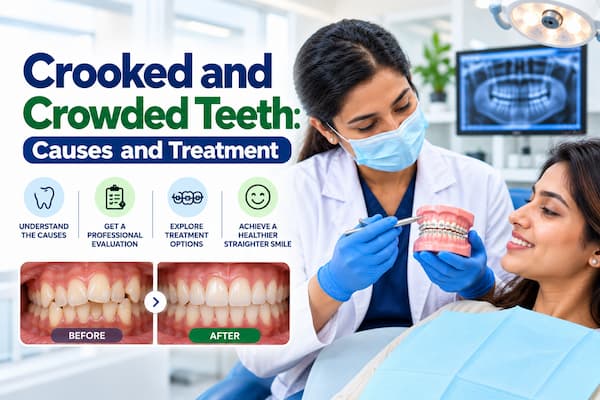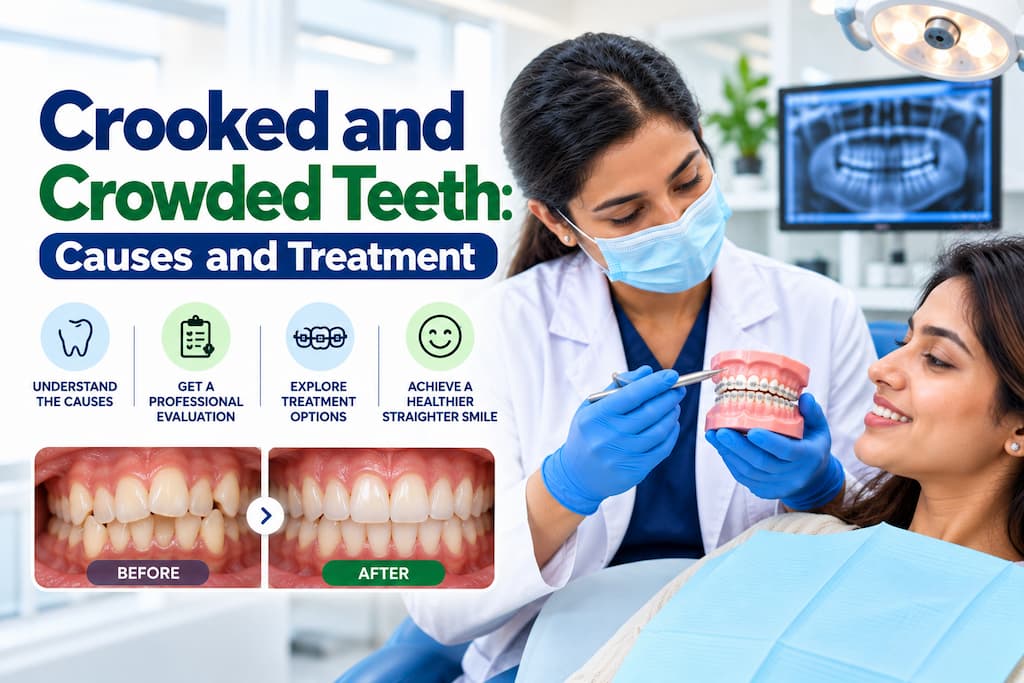
Quick answer: Crooked or crowded teeth usually happen because the jaw is too small for the teeth, sometimes made worse by early loss of milk teeth or habits like thumb sucking. Braces or clear aligners straighten them at any age, and a retainer keeps them straight afterwards. Metal braces at Teeth Care start at INR 55,000.
Floss tells you a lot. If it snaps, shreds or simply will not go between two of your front teeth, those teeth are probably overlapping. That is crowding, and for most people it is the first practical sign that crooked teeth are more than a looks issue.
In Hindi most patients just say "daant tedhe medhe hain". Crooked teeth get around 9,900 searches a month in India, and crowded teeth another 2,400. What follows explains why it happens, what it does to your teeth over time, and the real options for fixing it, including the ones that do not involve metal braces.
Why Teeth Grow In Crooked
Your teeth and your jaw are inherited separately. If you got larger teeth from one parent and a smaller jaw from the other, the teeth simply do not fit in a straight line, so they rotate, overlap or push forward. This mismatch is the most common cause of crowding by a wide margin.
Other things make it worse:
- Losing milk teeth too early. A milk tooth holds space for the permanent tooth underneath. If it is lost early to decay, the neighbouring teeth drift into the gap and the permanent tooth comes in crooked or gets blocked.
- Thumb sucking and long pacifier use. Steady pressure over years pushes the front teeth forward and narrows the upper jaw.
- Tongue thrusting and mouth breathing. Both change the balance of pressure from the lips, cheeks and tongue that normally guides teeth into line.
- Extra or missing teeth. An extra tooth crowds the arch, while a missing one lets the others tip and drift.
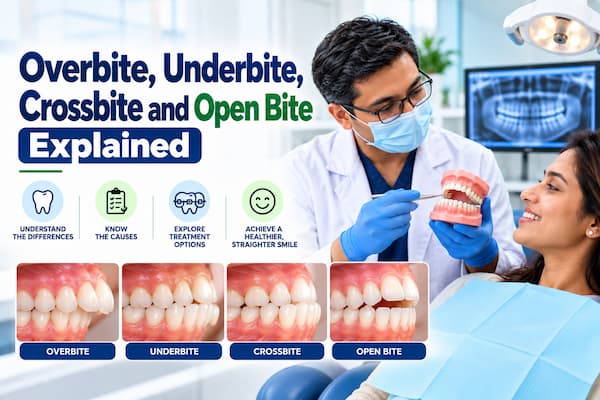
The Cleveland Clinic lists crowded and crooked teeth among the main forms of malocclusion, along with bite problems such as overbite and crossbite. The two often show up together. If your teeth are crowded and also do not meet properly, read our guide to overbite, underbite, crossbite and open bite.
Teeth That Get Crooked in Your 20s and 30s
A lot of adults tell us their teeth were straight at school and started overlapping later. That is real and it is common. Teeth keep moving slowly for life, and the lower front teeth in particular tend to crowd as we age.
Wisdom teeth usually get the blame, and plenty of people have them removed for that reason. The evidence for it is weak. Late crowding of the front teeth also happens in people whose wisdom teeth never came in, and most orthodontists now see it as normal age-related change rather than something the wisdom teeth push into place. Wisdom teeth come out for their own reasons: pain, infection or decay.
If you had braces as a teenager and stopped wearing your retainer, that is the other usual explanation. Teeth that were moved tend to drift back.
Is It Only Cosmetic?
Mild crowding that you can clean properly is mostly a cosmetic choice. Moderate and severe crowding causes problems you will not see in the mirror:
- Plaque collects in the overlaps where the brush cannot reach, so those spots get cavities and gum inflammation first
- Teeth that stick out of line take more force when you chew and wear or chip faster
- A tooth pushed outside the arch often has thinner gum and bone over it, and the gum can recede
- Food traps between rotated teeth, which is a common cause of bad breath
So the honest answer is: cosmetic when mild, a long-term health issue when the overlaps cannot be cleaned.
Treatment Options Compared
| Option | How it works | Best for | Visible? |
|---|---|---|---|
| Metal braces | Brackets and a wire move the teeth steadily | Any level of crowding, including severe | Yes |
| Ceramic braces | Same as metal, with tooth-coloured brackets | Any level, if you want them less noticeable | Less |
| Clear aligners | A series of removable trays, each changed every week or two | Mild to moderate crowding | Barely |
| Veneers | Thin shells on the front of the teeth hide minor rotation | Very mild cosmetic cases only | No |
Veneers are sometimes sold as "instant orthodontics". They can disguise a slightly turned tooth, but they do not move anything, and to cover real crowding the dentist has to remove a lot of healthy enamel. For anything beyond a very small rotation, moving the teeth is the better treatment.
The choice between braces and invisible braces mostly comes down to how severe the crowding is and how disciplined you are. Aligners only work if you wear them 20 to 22 hours a day. Our comparison of invisible braces vs metal braces covers the trade-offs in detail.
How Orthodontists Make Room
Crowding means there is not enough space, so straightening the teeth starts with creating some. There are three ways to do it, and your orthodontist chooses based on how many millimetres are missing:
- Expansion. Widening the arch slightly. In children, an expander can widen the upper jaw itself while it is still growing. In adults, braces can only tip the teeth outwards a little.
- Interproximal reduction. Polishing a fraction of a millimetre of enamel from the sides of several teeth. Spread across the arch this frees up a few millimetres, and it is painless.
- Extraction. In severe crowding, removing two or four premolars gives the room needed to line up the rest. It sounds drastic, but it is a standard and well-studied approach when the shortfall is large.
Ask about this at your consultation. If one clinic says extraction and another says no extraction for the same mouth, the difference is usually how much expansion each is willing to try.
Keeping Them Straight
The most common way to waste money on straightening is to skip the retainer afterwards. Teeth sit in gum fibres that stretch during treatment and pull back for months after. A retainer holds them while the fibres settle, and for most people some form of night-time retainer is a long-term habit.
During treatment, cleaning around brackets takes extra effort. Our tips on taking care of your braces cover what to brush, what to avoid eating and what to do if a wire pokes.
Crooked Teeth Treatment Cost in Kolkata
| Treatment | Starting price |
|---|---|
| Metal braces | From INR 55,000 |
| Ceramic braces | From INR 85,000 |
| Clear aligners | INR 1,20,000 to INR 4,00,000 |
Simple crowding can be finished in under 12 months, while severe crowding or crowding combined with a bite problem can take two years or more. Every figure here is a starting price, and the final cost is set after an examination and X-rays. Our braces cost guide has the full breakdown, including EMI options.
Crowding cases at all five branches (New Town, Chinar Park, Ballygunge, Dunlop and Charnock) are planned by our consultant orthodontist, Dr. Jeet Singh, BDS, MDS.
Frequently Asked Questions
What causes crooked teeth?
Mostly a jaw too small for the teeth, plus early milk tooth loss or habits like thumb sucking.
Can crooked teeth be fixed without braces?
Yes, mild to moderate cases can be fixed with clear aligners, which are removable and nearly invisible.
Do wisdom teeth make front teeth crooked?
The evidence for this is weak, and front teeth also crowd with age in people without wisdom teeth.
Is it too late to straighten teeth as an adult?
No, teeth can be moved at any age, though adult treatment can take slightly longer.
Will I need teeth removed for braces?
Only in severe crowding, and many cases are treated with expansion or enamel polishing instead.
How long does it take to straighten crooked teeth?
Simple cases take under 12 months, while severe crowding can take two years or more.
How much does crooked teeth treatment cost in Kolkata?
Metal braces start at INR 55,000, ceramic at INR 85,000 and clear aligners at INR 1,20,000.
Find Out What Your Teeth Need
Book an orthodontic check at any of our 5 Kolkata branches and get a treatment plan with a clear price before you commit.
Book Consultation NowMedically reviewed by Dr. Sanket Chakraverty, B.D.S., M.D.S. Prices are starting prices for 2026 and are confirmed after an examination. This article is general information and does not replace a consultation.