
Teeth Care Multispeciality Dental Clinic is a leading multispeciality dental chain that offers world-class dental treatment to its patients. Using the latest technology, we serve patients to restore their oral health.
Teeth Care Multispeciality Dental Clinic is a leading multispeciality dental chain that offers world-class dental treatment to its patients. Using the latest technology, we serve patients to restore their oral health.

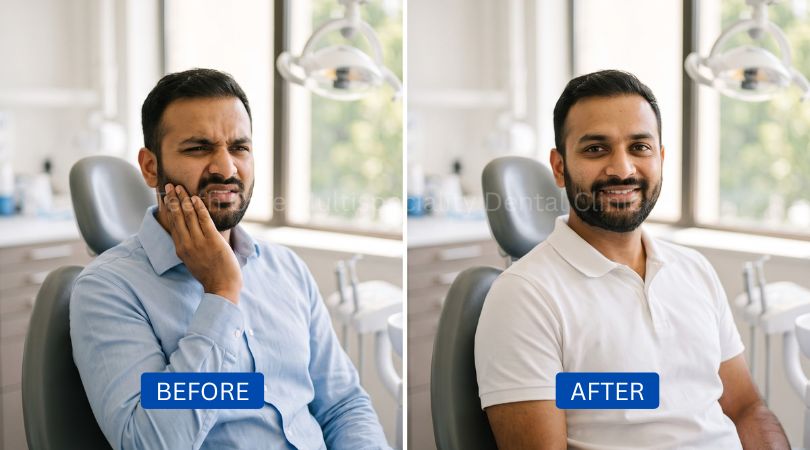
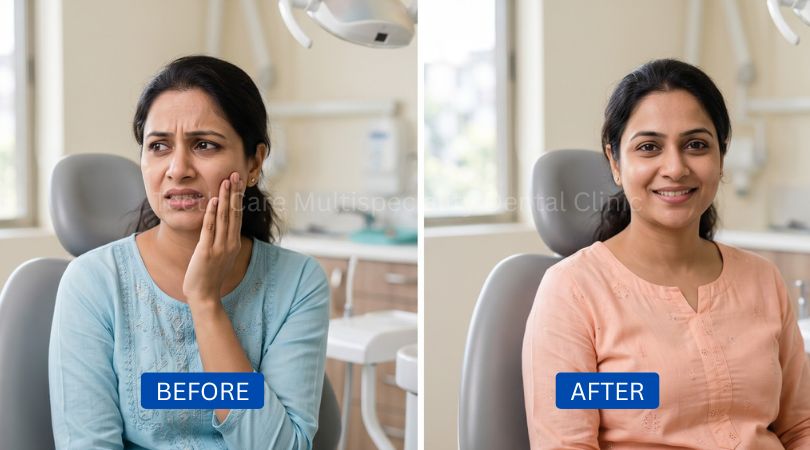
A tooth extraction is the removal of a tooth that cannot be repaired or that is causing harm where it sits. It is one of the most common procedures we carry out, and also the one we try hardest to avoid. A natural tooth holds the bone around it, keeps the neighbouring teeth in place and does a job no replacement copies exactly.
At Teeth Care Multispeciality Dental Clinic, extractions are done by our oral and maxillofacial surgeons under local anaesthesia. You are numb before anything starts, you feel pressure rather than pain, and you go home the same day. This page sets out what each type costs, what the alternatives are, and what the socket needs while it heals.
These are our starting prices, effective 15 June 2026. The exact figure for your tooth is confirmed after the X-ray, because a tooth that looks simple can turn out to have curved roots, and a tooth that looks difficult sometimes lifts out cleanly.
| Type of extraction | Starting cost | When it applies |
|---|---|---|
| Simple extraction | INR 1,200 to 1,500 | Tooth fully visible above the gum, roots straight |
| Multiple extraction | INR 1,000 to 1,500 per tooth | Several teeth removed in the same appointment |
| Surgical extraction | INR 2,800 to 3,700 | Tooth broken at the gum line or roots curved |
| Impacted tooth | INR 3,000 | Tooth trapped under gum or bone |
| Wisdom tooth | INR 3,500 to 5,000 | Third molar, position decides the price |
Removing several teeth in one appointment works out cheaper per tooth than booking them separately, because the anaesthesia and the setup are shared across the visit.
Two things decide which category your tooth falls into: how much of it is above the gum, and which way the roots point. Both are visible on the X-ray before we start.
| Position | What it means | Typical cost |
|---|---|---|
| Fully erupted | Tooth is through and reachable | INR 3,500 |
| Partially erupted | Part through the gum, food traps around it | INR 3,500 to 4,000 |
| Mesioangular | Tilted forward into the tooth in front | INR 4,000 to 4,500 |
| Horizontal or fully bony | Lying sideways or covered by bone | INR 4,500 to 5,000 |
Extraction is the right answer when the tooth cannot be restored or when leaving it causes more damage than removing it. The usual reasons:
Most extraction pages sell extraction. We would rather be straight with you: keeping your own tooth is the better outcome almost every time, and it usually costs less over the years. Before we take a tooth out, we check whether one of these will do the job.
| Option | Starting cost | When it works |
|---|---|---|
| Filling | INR 800 | Decay has not reached the nerve |
| Root canal treatment | INR 5,000 | Nerve is infected but the tooth structure is sound |
| Crown lengthening | INR 2,000 | Tooth broken near the gum, more of it needs exposing |
| Extraction | INR 1,200 | Nothing above will hold, tooth cannot be restored |
Extraction is the cheapest line on that table on the day, and the most expensive one over five years. A root canal at INR 5,000 keeps the tooth. An extraction at INR 1,200 leaves a gap that costs INR 22,000 upwards to fill with an implant. Our blog goes into this in detail: root canal versus extraction, making the right decision.
Not during the procedure. The area is fully numbed with local anaesthesia before anything begins, so what you feel is pressure and movement rather than pain. If you feel anything sharp, you tell us and we top up the anaesthetic.
Afterwards is a different question, and we will not pretend otherwise. Expect soreness for two to three days, and some swelling for the first 48 hours if the extraction was surgical. Ordinary painkillers handle it. By day four most people have forgotten about it.
For patients who are genuinely anxious about dental treatment, sedation is available. Extraction under general anaesthesia is rarely necessary.
| Time | What is happening | What to do |
|---|---|---|
| First 24 hours | Clot forms in the socket | No rinsing, no spitting, no straws, no smoking |
| Day 2 to 3 | Swelling peaks then starts to settle | Warm salt water rinses, soft food, painkillers if needed |
| Day 4 to 7 | Gum tissue begins closing over | Gentle brushing near the site, back to normal routine |
| Week 2 | Gum has closed | Stitches reviewed or removed if not dissolving |
| Week 6 to 8 | Bone fills in underneath | Right time to plan an implant or bridge |
The first 24 hours matter more than the rest of the fortnight put together. Everything in this table protects the clot sitting in the socket. The column on the right is where almost every complication we see comes from.
| Do's | Don'ts |
|---|---|
|
|
Dry socket happens when the clot is lost too early and the bone underneath is left exposed. It is uncommon, and it is almost always preventable.
The pattern is distinctive. The pain settles for two or three days as expected, then returns sharply and spreads towards the ear on that side. There may be a bad taste or a visible empty socket. This is not something to wait out. Call us and we will see you the same day. It is treated quickly with a medicated dressing and the relief is immediate.
Smoking is the leading cause. Straws and vigorous rinsing on the first day come next.
For most teeth other than wisdom teeth, replacement matters. A gap lets the neighbouring teeth drift into the space and the tooth above or below drops down. The bone in that area shrinks over time, which makes an implant more complicated and more expensive later. Wisdom teeth are the exception, and our guide on when a wisdom tooth needs removal lists the signs.
| Replacement | Starting cost | Notes |
|---|---|---|
| Dental implant | INR 22,000 | Closest to a natural tooth, preserves the bone |
| Premium implant | INR 35,000 to 45,000 | International implant systems |
| Removable partial denture | INR 1,500 | Most affordable option |
| Cast partial denture | INR 2,700 per tooth | Better fit and longer lasting |
The bone needs six to eight weeks to fill in before an implant is placed, so there is no rush to decide on the day of the extraction.
Extractions here are done by oral and maxillofacial surgeons, not passed along. Every case starts with an X-ray and a straight answer about whether the tooth can be saved. The price is set out before we begin and does not move afterwards. EMI is available at all five branches, and emergency slots are kept open for acute pain.
The clinic has been running since 2006 and has grown to five branches across Kolkata in that time.
Extractions are carried out at every one of our clinics, so you can pick whichever is nearest.
Come in for an X-ray and a clear answer on whether the tooth can be saved, along with an exact price. Same-day appointments are available for pain, at all five Kolkata branches, with EMI options.
Book Appointment WhatsApp for Price Quote Call +91 98315 26251Simple extraction starts at INR 1,200. Surgical is INR 2,800 to INR 3,700, and wisdom tooth removal INR 3,500 to INR 5,000.
Upfront yes, INR 1,200 against INR 5,000. Over time no, because replacing the tooth costs far more than saving it.
Not during the procedure. The area is fully numbed, so you feel pressure but not pain. Soreness for two to three days afterwards is normal.
No more than any other extraction. Wisdom teeth take longer to remove, not more anaesthetic.
Ten to twenty minutes for a simple case. A surgical or impacted tooth takes 30 to 60 minutes.
The gum closes in about two weeks. The bone underneath keeps filling in for six to eight weeks.
Rarely needed. Local anaesthesia covers almost every case, with sedation available for anxious patients.
None for a simple extraction. One to two days for a surgical or wisdom tooth case.
Soft, cool food for the first two days. Curd, khichdi, dal and mashed potato all work well.
Brush your other teeth from day one, avoiding the socket. Gentle brushing near the site can start around day four.
Avoid it for at least 72 hours. Smoking is the leading cause of dry socket.
Pain that settles for two to three days then returns sharply, spreading to the ear. Call us, as it is treated quickly with a dressing.
Often yes, with root canal treatment from INR 5,000. An X-ray settles it in one visit.
For most teeth, yes. A gap lets the neighbouring teeth drift and the bone shrink over time.
Yes when necessary, ideally in the second trimester. Tell us how far along you are so medication can be adjusted.
Medically necessary extractions are covered by some policies, particularly surgical ones. Check with your insurer.
Medically reviewed by Dr. Arimeeta Chakraverty, BDS, MDS, Oral and Maxillofacial Surgery.
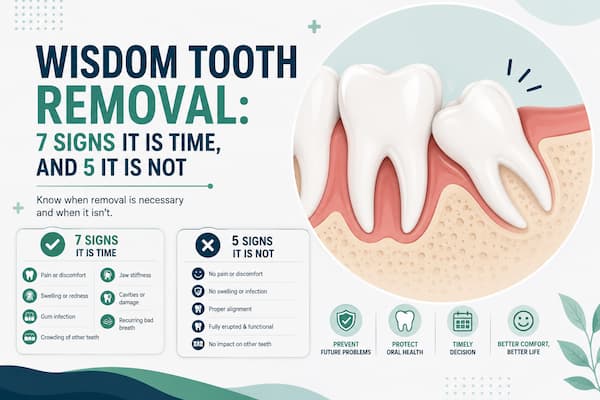
Wisdom tooth removal is not always necessary. Here are 7 signs the tooth needs to come out, 5 signs it can safely stay, and what the procedure costs in Kolkata.
Choose Teeth Care for your oral surgery needs. We offer personalized treatment plans, affordable pricing, and the best dental technology in Kolkata.