Quick answer: Pyorrhea, or pyria, is a gum infection that slowly eats away the bone holding your teeth (the medical name is periodontitis). Home remedies cannot reverse it, but treatment can control it. At Teeth Care, deep cleaning for early pyorrhea starts from INR 3,500, and gum surgery for advanced cases starts from INR 8,000 per quarter of the mouth.
Most people find out about pyorrhea in small steps. First a little pink in the sink after brushing. Then a bad taste in the morning that the first cup of cha does not wash away. Months later, a back tooth feels slightly different when you bite down. If that sounds familiar, this guide explains what is going on and what gum treatment in Kolkata involves at each stage, with starting prices.
You are far from alone. A 2020 review of 30 Indian studies, covering more than 92,000 adults, found that about half of Indian adults have some form of gum disease and roughly one in five has the severe form. Because the early years are usually quiet, many people only learn they have pyorrhea when it is already costly to fix.
Table of Contents
- What Is Pyorrhea?
- Symptoms of Pyorrhea
- The 4 Stages of Pyorrhea
- What Causes Pyorrhea?
- Can Pyorrhea Be Cured?
- Pyorrhea Treatment Options and Cost in Kolkata
- Home Care That Helps, and Home Remedies That Do Not
- What Happens If Pyorrhea Is Left Untreated?
- Conclusion
- About the Author
- Frequently Asked Questions
- References
What Is Pyorrhea?
Pyorrhea and pyria are the names most families in Kolkata use. Your dentist may write periodontitis on the prescription, but it is the same disease. The word pyorrhea comes from the Greek for "flow of pus", which is what doctors used to see in advanced cases.
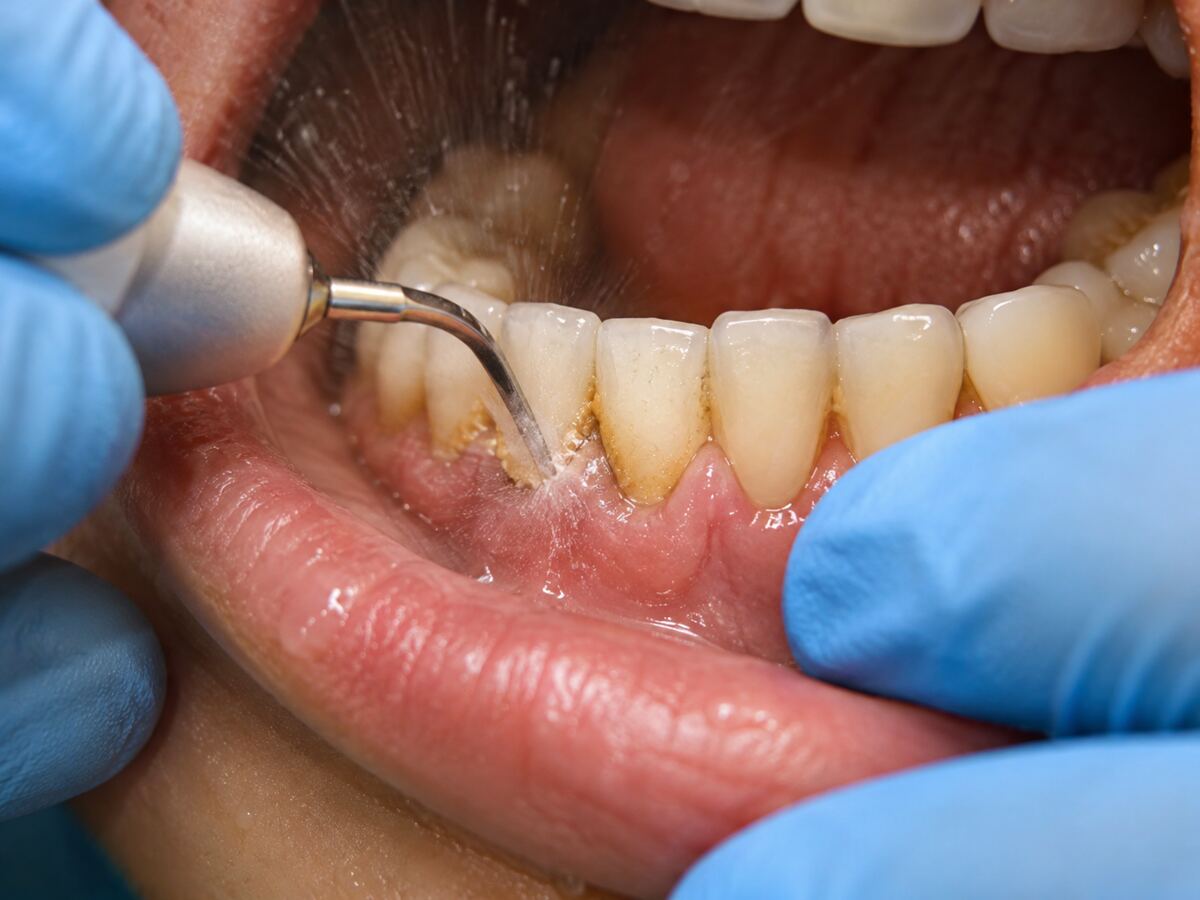
It starts with the soft, sticky layer of germs that builds up on teeth every day (plaque). If it is not cleaned off, within days it hardens into a yellow or brown crust along the gum line (tartar, also called calculus), and no toothbrush can remove that. The gums around it get irritated, swell and bleed. This early stage, when only the gums are affected, is called gingivitis.
Early gum disease can be fully reversed. Pyorrhea is what happens when it is not. The infection moves under the gum, the gum comes away from the tooth and leaves a gap where germs collect (a gum pocket), and the body's own fight against those germs starts wearing away the bone around the root. Once bone starts to go, it is pyorrhea.
Symptoms of Pyorrhea
The hard part is that pyorrhea usually does not hurt until it is well along. These are the signs to take seriously:
- Gums that bleed when you brush, floss or eat something hard
- Red, swollen or tender gums instead of firm pink ones
- Bad breath or a bad taste that keeps coming back after brushing
- Pus between a tooth and the gum when you press on it
- Gums shrinking back, so teeth look longer than before (receding gums)
- New gaps between teeth, or front teeth slowly fanning out
- A tooth that feels loose, or a bite that suddenly feels different
- Pain while chewing, which tends to show up late
When gums shrink back, the root of the tooth is left uncovered, so cold water or sweets may start to sting. If that is your main complaint, our guide to tooth sensitivity treatment covers it in detail.
The 4 Stages of Pyorrhea
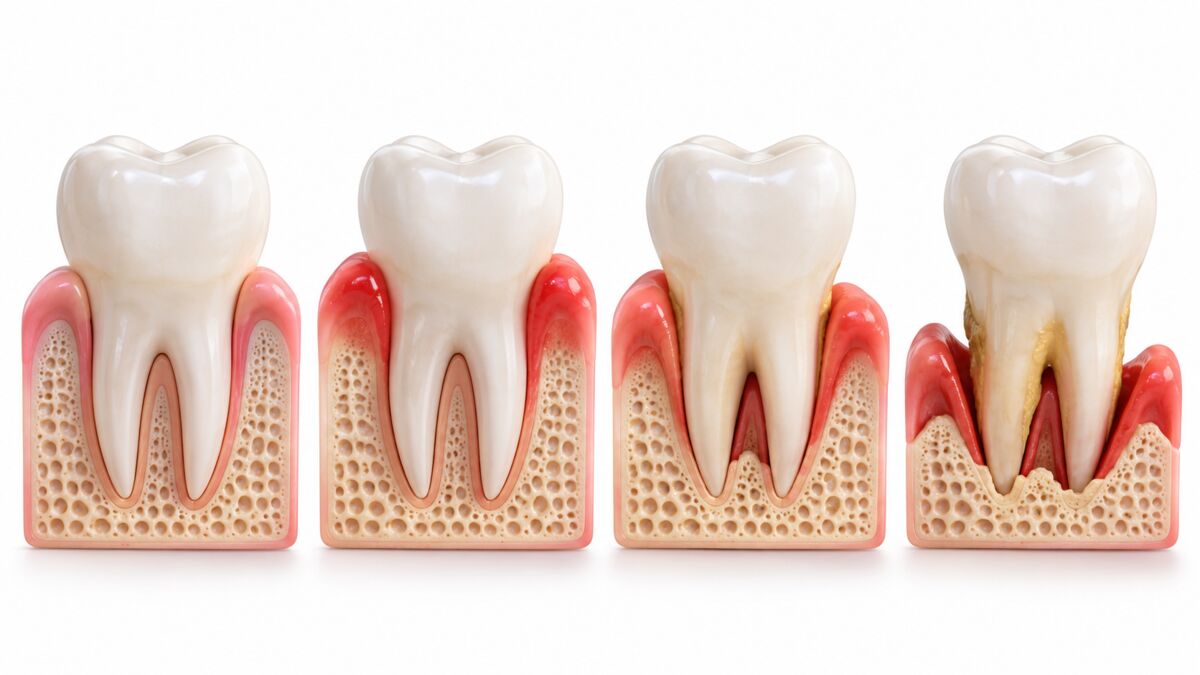
Since 2018, dentists divide pyorrhea into 4 stages, using a system set by the American Academy of Periodontology and the European Federation of Periodontology. The stage depends on how much of the bone and gum holding your teeth has already been lost. To find your stage, the dentist measures the gaps between your gums and teeth with a thin measuring tool (a periodontal probe) and checks the bone on an X-ray. Here is what each stage means in plain words.
| Stage | What is happening | What you may notice | Usual treatment |
|---|---|---|---|
| Early gum disease, before pyorrhea (gingivitis) | Gums are swollen, no bone lost yet | Bleeding while brushing, puffy gums | Teeth cleaning (scaling and polishing), better brushing |
| Stage 1: early pyorrhea | Small gaps between gum and tooth, a little bone lost near the top of the root | Bleeding, bad breath, often nothing else | Deep cleaning (scaling and root planing) |
| Stage 2: moderate | Bone lost up to about a third of the root | Gums shrinking back, teeth sting with cold | Deep cleaning, then a recheck after healing |
| Stage 3: severe | Deep gaps, bone lost to the middle of the root or further, some teeth may be lost | Loose teeth, pus, gaps opening up | Deep cleaning, then gum surgery (flap surgery) or laser treatment where gaps stay deep |
| Stage 4: advanced | Heavy bone loss, several teeth lost or failing, teeth no longer meet properly when you bite | Difficulty chewing, teeth drifting | Gum treatment plus replacing lost teeth, planned together |
The dentist also notes how fast the disease is spreading, as grade A, B or C. Smoking and uncontrolled diabetes push the grade up, which is why your dentist will ask about both.
What Causes Pyorrhea?
The germs in plaque are the cause. What decides whether those bacteria stay a nuisance or start destroying bone is a mix of habits and health:
- Tartar that never gets cleaned. Brushing cannot remove it. Only a cleaning at the dentist can.
- Tobacco in any form. Smoking is a well established risk. Smokeless tobacco matters too: a 2025 study of more than 1,000 adults in Chhattisgarh found that people who used gutkha or khaini had deeper gaps between gums and teeth and more shrinking of the gums than people who used no tobacco, and gutkha showed the strongest link. Paan with tobacco falls in the same group.
- Diabetes. The link runs both ways. High blood sugar makes pyorrhea worse, and pyorrhea makes blood sugar harder to control.
- Teeth that are hard to clean. Crowded teeth, old fillings with rough edges and badly fitting crowns trap plaque.
- Other factors. Family history, hormonal changes such as pregnancy, stress, and medicines that cause a dry mouth.
Paan and tobacco also leave heavy brown stains. If you are dealing with those too, see how teeth stains are removed.
Can Pyorrhea Be Cured?
Most people want a yes or a no here. The honest answer sits in between.
The infection can be brought under control. After treatment, bleeding stops, the gaps between gums and teeth get smaller, swelling settles and loose teeth often firm up. What does not happen on its own is the bone growing back. Bone that is already lost stays lost, although in selected cases a bone-rebuilding surgery (regenerative surgery) can bring some of it back.
It helps to think of pyorrhea the way you think of blood pressure. Once it is under control, it stays under control with regular check-ups and good daily cleaning. Skip the regular check-up cleanings and it can come back. That is why the treatment plan has a step for after the treatment.
Pyorrhea Treatment Options and Cost in Kolkata
Treatment follows the stepwise order set out in the European Federation of Periodontology's clinical guideline. Each step is added only if the one before it was not enough.
- Step 1: Cleaning and habits. Removing plaque and tartar above the gum, showing you a cleaning routine that works for your teeth, and help to stop tobacco.
- Step 2: Deep cleaning (scaling and root planing). The dentist cleans tartar and germs off the root, under the gum, usually after a numbing injection (local anaesthesia). The gums are rechecked once they have healed, usually a few weeks later.
- Step 3: Gum surgery where gaps stay deep (flap surgery). The dentist gently lifts the gum to reach and clean deep gaps directly. Laser treatment is used for suitable cases.
- Step 4: Regular check-up cleanings (maintenance). Cleanings at the dentist at an interval set for you, so the disease does not return.
Many early cases are managed with steps 1 and 2 alone. Here are the starting prices at Teeth Care:
| Treatment | Starting price | Usually needed for |
|---|---|---|
| Teeth cleaning (scaling and polishing) | From INR 2,500 | Early gum disease, and regular check-up cleanings |
| Deep cleaning (scaling and root planing) | From INR 3,500 | Stage 1 and 2 pyorrhea |
| Laser gum treatment | From INR 8,000 | Selected cases, alongside deep cleaning |
| Gum surgery (flap surgery) | From INR 8,000 per quarter of the mouth | Stage 3 and 4, gaps that stay deep |
| Gum graft to cover exposed roots (gum grafting) | From INR 15,000 | Gums that have shrunk back and left roots uncovered |
Dentists divide the mouth into four quarters (quadrants), so the final cost depends on how many quarters need work. Every figure above is a starting price, and the exact plan is confirmed after the examination and X-ray. For cleaning on its own, see our teeth scaling cost in Kolkata page.
Home Care That Helps, and Home Remedies That Do Not
What you do at home decides whether the treatment lasts. These habits make a real difference:
- Brush twice a day for two minutes with a soft brush, angled towards the gum line
- Clean between your teeth every day with floss or a small brush made for the gaps (interdental brush), because a toothbrush does not reach there
- Stop smoking, gutkha and khaini, and ask your dentist for help if quitting is hard
- Keep your blood sugar under control if you have diabetes
- Use a mouthwash your dentist prescribes, and only for as long as they suggest
Then there are the remedies that get passed around in every family: rubbing mustard oil and salt on the gums, alum (phitkari), clove oil, or a new herbal toothpaste. Some of these may soothe sore gums for a while. None of them can remove tartar from under the gum line, and that is where pyorrhea lives. Relying on them alone gives the infection more time to eat into bone.
What Happens If Pyorrhea Is Left Untreated?
Pyorrhea moves slowly, which is exactly why it gets ignored. Over the years, the gaps between gums and teeth get deeper, more bone is lost, teeth loosen and drift, and eventually teeth are lost. Chewing becomes harder, and for people with diabetes, the ongoing gum infection makes blood sugar harder to manage.
Replacing a lost tooth costs many times more than saving it. If you want to see the numbers, our dental implant cost guide and denture cost guide list what each option starts from. Set those next to deep cleaning from INR 3,500 and the case for treating early makes itself.
Not Sure Which Stage Your Gums Are At?
See how gum disease is checked and treated at Teeth Care, from deep cleaning to gum surgery.
View Gum Treatment OptionsConclusion
Pyorrhea is the stage of gum disease where the infection has started taking bone. Half of Indian adults have some form of gum disease, and because the early stages rarely hurt, most people only act when a tooth starts to move. Tobacco and diabetes speed it up. Home remedies will not reverse it, but treatment can control it, and the earlier it starts, the simpler and cheaper it is.
If your gums bleed regularly, smell bad or have started to shrink back, get them checked rather than waiting for a loose tooth. Our gum treatment page explains each option in more detail.
About the Author
Dr. Arimeeta Chakraverty is an oral and maxillofacial surgeon and one of the chief dentists at Teeth Care Multispeciality Dental Clinic. She completed her B.D.S. at MGV KBH Dental College & Hospital (Maharashtra University of Health Sciences) and her M.D.S. in Oral and Maxillofacial Surgery at S.R.M. Dental College & Hospital, Chennai. She writes on oral surgery, extractions and gum health.
Frequently Asked Questions
Can pyorrhea be cured permanently?
It can be controlled and kept stable, but bone that is already lost does not grow back on its own.
Is pyorrhea contagious?
It does not spread like a cold, but the bacteria can pass through saliva, so do not share toothbrushes.
How much does pyorrhea treatment cost in Kolkata?
Deep cleaning starts from INR 3,500, and gum surgery for advanced cases starts from INR 8,000 per quarter of the mouth.
Can teeth loosened by pyorrhea be saved?
Often yes, if enough bone is left. The dentist decides after measuring your gums and checking an X-ray.
What is the difference between gingivitis and pyorrhea?
Gingivitis is early gum disease with swollen, bleeding gums and no bone lost, and it can be reversed. In pyorrhea, the bone has started to wear away.
How long does pyorrhea treatment take?
Deep cleaning takes one or a few visits, and the gums are rechecked a few weeks later once they have healed.
References
- Janakiram C. et al., Journal of Oral Biology and Craniofacial Research (2020): Prevalence of periodontal disease among adults in India, a systematic review and meta-analysis
- Tonetti M.S., Greenwell H., Kornman K.S., Journal of Periodontology (2018): Staging and grading of periodontitis, framework and proposal of a new classification
- Sanz M. et al., Journal of Clinical Periodontology (2020): Treatment of stage I to III periodontitis, the EFP S3 level clinical practice guideline
- Sanz M. et al., Journal of Clinical Periodontology (2018): Scientific evidence on the links between periodontal diseases and diabetes, IDF and EFP consensus report
- Siddiqui et al., Frontiers in Oral Health (2025): Prevalence of smokeless tobacco use and its impact on periodontal health among adults in Rajnandgaon, Chhattisgarh, India