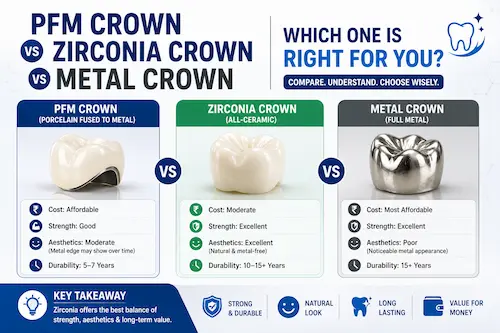
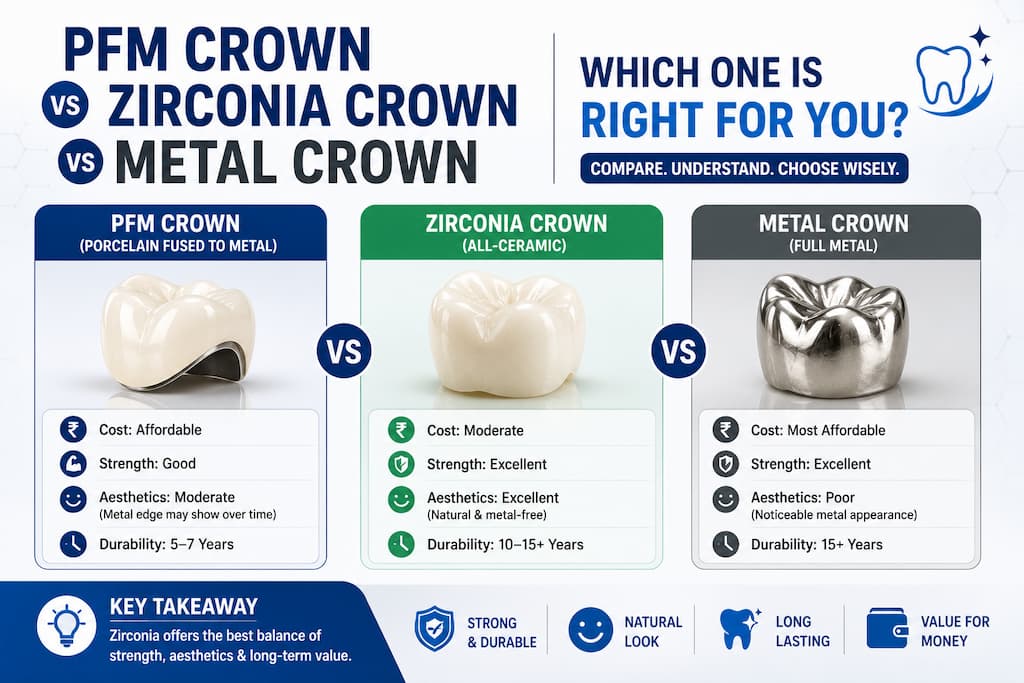
A PFM crown (Porcelain Fused to Metal), a zirconia crown, and a metal crown are the three most commonly placed dental crowns in India today. Each type is made from different materials and offers a different combination of strength, appearance, and biocompatibility. Choosing the wrong crown can affect your smile and your oral health for the next 10 to 20 years, so understanding the difference matters.
At Teeth Care Multispeciality Dental Clinic, Kolkata, our dental specialists work with all three crown types and guide each patient to the best choice for their specific tooth, bite, and lifestyle. This guide covers everything you need to know before your crown appointment - from material science to maintenance.
In This Article
- When Do You Need a Dental Crown?
- How is a Dental Crown Made?
- Metal Crown - Materials, Pros, Cons and Care
- PFM Crown - Materials, Pros, Cons and Care
- Zirconia Crown - Materials, Pros, Cons and Care
- Side-by-Side Comparison Table
- Crown Placement Process at Teeth Care Kolkata
- How to Care for Your Dental Crown
- Signs Your Crown Needs Replacement
- Which Crown is Right for You?
- Frequently Asked Questions
When Do You Need a Dental Crown?
A dental crown is a tooth-shaped cap that fits over a prepared tooth to restore its shape, size, strength, and appearance. Your dentist will recommend a crown in the following situations:
- After root canal treatment: A root canal removes the pulp from a tooth, making it more brittle. A crown protects the tooth from fracture.
- Severely decayed tooth: When a cavity is too large for a filling to hold, a crown covers and protects what remains of the tooth structure.
- Cracked or fractured tooth: A crown holds the tooth together and prevents the crack from spreading further.
- Dental implant restoration: A crown is placed on top of a dental implant to replace a missing tooth.
- Worn-down teeth: Teeth worn due to grinding (bruxism) or acid erosion are restored with crowns to bring back proper bite height.
- Cosmetic improvement: Severely discoloured or misshapen teeth that cannot be corrected with veneers are covered with crowns.
- Dental bridge anchor: Crowns on adjacent teeth hold a dental bridge in place to replace a missing tooth.
How is a Dental Crown Made?
Regardless of the material, all dental crowns go through a similar fabrication process:
Tooth Preparation
The tooth is filed down to create space for the crown to fit over it.
Impression
A mould or digital scan of the prepared tooth is taken and sent to the lab.
Crown Fabrication
The dental lab manufactures the crown using the chosen material (metal, PFM, or zirconia).
Final Placement
At your second visit, the permanent crown is checked for fit, then cemented permanently.
At Teeth Care Kolkata, we use CAD/CAM (Computer-Aided Design/Manufacturing) technology for zirconia crowns, which ensures precise fitting and reduces the chance of gaps or discomfort after placement.
Metal Crown - Materials, Pros, Cons and Care
Metal crowns are made from metallic alloys. The most commonly used metals for dental crowns include gold alloy, chromium-cobalt alloy, and nickel-chromium alloy. Metal crowns have the longest track record in dentistry and remain the strongest crown type available.
Types of Metal Used
- Gold alloy: Biocompatible, gentle on opposing teeth, rarely causes allergic reactions. Used less today due to high cost and visible appearance.
- Chromium-cobalt alloy: Most common metal crown material today. Strong, durable, and more affordable than gold.
- Nickel-chromium alloy: Used in some cases but can trigger nickel allergy in sensitive patients.
Advantages
- Highest durability - can last 20 to 30+ years with proper care
- Requires the least amount of natural tooth removal during preparation
- Very rarely chips, cracks, or fractures
- Withstands the highest bite forces - ideal for grinding patients
- More affordable than zirconia
- Simple to fabricate - faster turnaround from lab
Disadvantages
- Highly visible metallic appearance - not suitable for front teeth
- Can cause galvanic sensitivity when near other metallic restorations
- Nickel alloy crowns can trigger allergic reactions
- Temperature sensitivity - metal conducts heat and cold more than ceramic
- Can cause dark discolouration of gum tissue over time
Care Tips for Metal Crowns
- Brush twice daily and floss around the crown margin carefully
- Avoid biting hard objects like ice or hard candy directly on the crown
- If you grind your teeth at night, wear a night guard to protect the crown and opposing teeth
- Visit your dentist every 6 months so the crown margin can be checked for any gaps or decay
PFM Crown (Porcelain Fused to Metal) - Materials, Pros, Cons and Care
A PFM crown (also called a porcelain fused to metal crown or metal ceramic crown) consists of two layers: a metal inner coping (substructure) that provides strength, and a layer of dental porcelain fused on top to give the crown a natural tooth-like appearance. PFM crowns were the gold standard in dentistry for over 40 years and are still widely used in India today.
The metal substructure in a PFM crown can be made from the same alloys used in full metal crowns - chromium-cobalt being the most common in India. The porcelain outer layer is fired onto the metal frame in a dental furnace at high temperatures to create a strong bond between the two materials.
The Dark Gum Line Issue Explained
The most commonly reported problem with PFM crowns is the dark grey or black line that appears at the gum margin over time. This happens for two reasons:
- Natural gum recession: As gums recede with age, the metal collar at the base of the crown becomes exposed and visible.
- Metal showing through: The porcelain layer at the crown's edge is thin, and the underlying metal can show through as a dark shadow, especially under bright light.
This dark line is permanent once it appears and can only be resolved by replacing the PFM crown with a zirconia crown.
Advantages
- More natural appearance than a full metal crown
- Strong metal substructure handles biting forces well
- Can be used on front and back teeth
- Long clinical history - dentists have decades of experience with them
- Generally more affordable than zirconia in some clinics
Disadvantages
- Dark grey line appears at the gum margin over time
- Porcelain layer can chip under high bite force or after trauma
- Contains metal - risk of allergy in sensitive patients
- Less translucent than natural teeth - looks slightly opaque under strong light
- Requires more tooth preparation than metal crown
- When porcelain chips, repair is difficult and often temporary
Care Tips for PFM Crowns
- Avoid biting very hard foods - the porcelain layer is vulnerable to chipping on hard objects
- Do not use teeth as tools (opening bottles, tearing packaging)
- If you grind teeth, use a night guard - grinding accelerates porcelain wear
- Check the gum margin regularly - if a dark line appears, discuss replacement with your dentist
Zirconia Crown - Materials, Pros, Cons and Care
A zirconia crown is made from zirconium dioxide (ZrO2), a type of ceramic material that is also used in aviation and medical joint replacements because of its exceptional strength and biocompatibility. In dentistry, zirconia crowns represent the most advanced option currently available and have become the preferred choice at Teeth Care Multispeciality Dental Clinic for most clinical situations.
Types of Zirconia Crowns
- Monolithic zirconia (full-contour): Made entirely from a single block of zirconia. Extremely strong, used mainly for back teeth. Slightly less translucent than layered zirconia.
- Layered zirconia: A zirconia substructure with a porcelain layer on top for enhanced aesthetics. Used for front teeth where natural translucency is important. More like a PFM in construction but fully metal-free.
- High-translucency zirconia: A newer generation of zirconia with improved optical properties that closely mimic natural tooth structure. Best for front teeth.
Advantages
- Fully metal-free: Zero metal content, zero risk of metal allergy or sensitivity
- Most natural appearance: Closest visual match to natural tooth enamel
- No dark gum line: The tooth-coloured material stays aesthetic even as gums recede with age
- Exceptional strength: Handles the highest bite forces without fracture - up to 1,200 MPa fracture resistance
- Highly biocompatible: Gum tissue integrates well around zirconia - less inflammation and better gum health
- Precision fit: CAD/CAM milled zirconia crowns achieve accuracy within 50 microns, reducing gaps at the margin
- Safe for all teeth: Front teeth, back molars, implant crowns, and bridges
- MRI compatible: Zirconia is non-metallic and does not interfere with MRI scans
Disadvantages
- Requires slightly more tooth preparation compared to metal crowns
- Monolithic zirconia can cause minor wear on opposing natural teeth in patients with heavy grinding (less common with high-translucency zirconia)
- Not all dental clinics have CAD/CAM equipment for high-precision zirconia fabrication
- Higher material cost than metal or PFM - though this is reducing as technology becomes more widespread
Care Tips for Zirconia Crowns
- Brush with a non-abrasive toothpaste - avoid highly abrasive whitening pastes that can scratch the surface over time
- Floss gently at the gum margin daily to keep the crown-tooth junction clean
- Zirconia is very strong, but avoid using your teeth to crack open nuts or bottles - this habit damages any crown
- If you have layered zirconia (porcelain over zirconia), the same care applies as PFM - avoid hard biting on the porcelain layer
- Regular 6-monthly dental check-ups to inspect the crown margin
PFM Crown vs Zirconia Crown vs Metal Crown - Side-by-Side Comparison
This table compares all three crown types on the factors that matter most. Note: cost is not included in this comparison as crown pricing at Teeth Care Kolkata depends on the specific tooth, brand, and individual treatment plan - your dentist will explain pricing clearly during consultation.
| Factor | Metal Crown | PFM Crown | Zirconia Crown |
|---|---|---|---|
| Material | Metal alloy (gold, chromium-cobalt) | Metal base + porcelain outer layer | Zirconium dioxide ceramic |
| Appearance | Metallic - clearly visible | Tooth-coloured with metallic base | Most natural - mimics real enamel |
| Strength | Excellent | Good | Excellent (up to 1200 MPa) |
| Metal-Free | No | No | Yes |
| Biocompatibility | Moderate | Moderate | High |
| Dark Gum Line Risk | Yes - metal shows at gum | Yes - appears over years | No |
| Chip or Fracture Risk | Very low | Moderate (porcelain can chip) | Very low (monolithic) |
| Suitable for Front Teeth | No | Yes (with limitation) | Yes - preferred choice |
| Suitable for Back Teeth | Yes - best option | Yes | Yes |
| Implant Crown Use | Yes | Yes | Yes - preferred |
| Allergy Risk | Possible (nickel) | Possible (metal base) | None |
| MRI Compatible | No - check with radiologist | No - check with radiologist | Yes - fully safe |
| Tooth Preparation Needed | Minimal | Moderate | Moderate |
| Estimated Lifespan | 20 to 30+ years | 10 to 15 years | 15 to 25+ years |
Crown Placement Process at Teeth Care, Kolkata
At Teeth Care Multispeciality Dental Clinic, we follow a precise two-visit crown placement protocol to ensure accuracy and patient comfort:
Preparation and Impression
- Local anaesthesia is administered
- The tooth is shaped and reduced to receive the crown
- A digital scan or physical impression is taken
- A temporary crown is placed to protect the tooth
- The impression is sent to our lab for crown fabrication
Final Placement
- Temporary crown is removed
- Permanent crown is tried in for fit, colour match, and bite check
- Any adjustments are made before cementation
- Crown is permanently cemented using dental luting cement
- Bite is rechecked and minor adjustments made if needed
How to Care for Your Dental Crown
A dental crown is a restoration, not a replacement for the natural tooth root. The tooth underneath the crown can still decay, and the gum tissue around it still needs care. Follow these guidelines regardless of which crown type you have:
Daily Oral Hygiene
- Brush twice daily with a soft-bristle toothbrush
- Use fluoride toothpaste
- Floss daily - especially at the crown margin where plaque builds up
- Use an antiseptic mouthwash to reduce bacteria
Dietary Habits
- Avoid biting hard objects - ice, hard candy, pens, bottle caps
- Limit very sticky foods (toffee, chewing gum) that can pull at the crown
- Chew hard foods on the side opposite to the crown initially
- Avoid using teeth to tear packaging or open bottles
Professional Care
- Visit your dentist every 6 months for check-up and cleaning
- Get X-rays periodically to check for decay beneath the crown
- Wear a night guard if you grind your teeth
- Report any change in bite or sensitivity immediately
Signs Your Dental Crown Needs Replacement
Even well-maintained crowns need replacement eventually. Watch for these signs:
- Dark line at the gum (PFM crowns): The metal coping is showing through and the crown's aesthetics cannot be restored without replacement.
- Chipped or fractured porcelain: If the porcelain on a PFM or layered zirconia crown chips significantly, replacement is usually needed.
- Pain or sensitivity under the crown: This can indicate decay has developed beneath the crown or the crown is no longer sealing properly.
- Crown feels loose: The dental cement may have washed out. Do not leave this untreated as decay can develop rapidly under a loose crown.
- Visible decay at the crown margin: Seen on X-ray or by your dentist at the junction where crown meets tooth.
- Crown falls off: Visit your dentist immediately. Keep the crown safe and bring it to the appointment.
- Gum recession exposing the crown edge: Can compromise both aesthetics and hygiene at the crown margin.
Which Crown is Right for You?
Here is a practical scenario-based guide to help you decide, based on the cases we see daily at our Kolkata branches:
Choose Zirconia Crown
Most natural look, no dark gum line risk, no metal content. High-translucency zirconia is indistinguishable from natural teeth under most lighting conditions.
Metal or Monolithic Zirconia
Metal crown is the strongest for extreme bite forces. Monolithic zirconia is the metal-free alternative if aesthetics matter even for back teeth.
Zirconia is the Only Safe Choice
Metal crown and PFM crown both contain metal alloys. Only zirconia is 100% metal-free and safe for patients with metal sensitivity or confirmed allergy.
Zirconia is Preferred
Zirconia crowns for implants provide the best aesthetic result, excellent biocompatibility around the implant-gum interface, and long-term durability.
Upgrade to Zirconia
If your PFM crown shows a dark gum line, chipped porcelain, or is over 10 years old, replacing it with a zirconia crown restores full aesthetics and adds years of life.
Zirconia - MRI Safe
If you require frequent MRI scans for any medical condition, zirconia is the safest crown material as it is completely non-metallic and does not interfere with imaging.
Frequently Asked Questions
What is a PFM crown and is it still used in 2026?
A PFM crown (Porcelain Fused to Metal crown) consists of a metal inner frame with a tooth-coloured porcelain outer layer. It was the most common dental crown type used globally for over 40 years. In 2026, PFM crowns are still used, especially for back teeth. However, in most modern dental practices in India, zirconia crowns are now preferred because they are metal-free, do not develop the dark gum line problem that PFM crowns are known for, and offer equal or better strength.
How long does a PFM crown last compared to zirconia?
A PFM crown typically lasts 10 to 15 years. The porcelain layer can chip under heavy biting forces and the dark metal line at the gum margin eventually becomes a cosmetic concern. A zirconia crown lasts 15 to 25+ years because it does not have a separate porcelain layer that can chip (in the case of monolithic zirconia) and has no metal component that can cause gum discolouration. Both require proper oral hygiene to achieve maximum lifespan.
Which crown is best for front teeth in Kolkata?
Zirconia crowns are the best choice for front teeth. They provide the most natural, translucent appearance, do not develop a dark grey line at the gum margin over time, and are fully metal-free. High-translucency zirconia crowns placed at Teeth Care Multispeciality Dental Clinic, Kolkata closely match the appearance of natural teeth under all lighting conditions. Metal crowns should not be used for front teeth. PFM crowns can be used but carry the risk of the visible dark gum line as gums recede with age.
Why does a dark line appear at the gum with a PFM crown?
The dark grey or black line that appears at the gum line of a PFM crown has two causes. First, as gums naturally recede with age, the metal collar at the base of the PFM crown becomes exposed and is visible as a dark line. Second, the porcelain at the edge of the crown is thinner and the underlying metal can cast a dark shadow through it even before recession occurs. This is a permanent condition and the only solution is to replace the PFM crown with a zirconia crown, which has no metal component and therefore no dark line problem.
Is a zirconia crown painful to get?
No, the crown placement procedure is carried out under local anaesthesia so you will not feel pain during the appointment. After the first visit (tooth preparation), some patients experience mild sensitivity to hot and cold for 2 to 5 days while wearing the temporary crown. This settles once the permanent zirconia crown is placed. If sensitivity continues after final placement, inform your dentist as adjustment may be needed.
Can I get a zirconia crown over an implant?
Yes, zirconia crowns are widely used for implant restorations and are in fact the preferred option for implant-supported crowns. The biocompatibility of zirconia means that gum tissue around the implant crown responds well with less inflammation compared to metal or PFM alternatives. The absence of metal also means no dark shadow at the gum-crown junction, which is particularly important for implants in the front teeth area.
How many visits does crown placement take at Teeth Care Kolkata?
Crown placement at Teeth Care Multispeciality Dental Clinic involves two visits. During the first visit, the tooth is prepared under local anaesthesia, an impression or digital scan is taken, and a temporary crown is placed. The impression is sent to our laboratory. During the second visit, which is usually 5 to 7 days later, the permanent crown is tried in for fit and bite check, any necessary adjustments are made, and the crown is then permanently cemented. Our five Kolkata branches at Chinarpark, NewTown, Ballygunge, Dunlop, and Charnock all follow this same protocol.
Can a dental crown fall off and what should I do?
Yes, a crown can come loose in rare situations - most commonly when the dental cement washes out over time or if decay develops at the crown margin. If your crown falls off: do not panic, do not attempt to recement it yourself, keep the crown safe in a clean container, and call your dentist immediately for an emergency appointment. Do not leave the tooth exposed for more than 24 to 48 hours as the prepared tooth underneath is sensitive and vulnerable to further damage. At Teeth Care Kolkata, we use high-quality dental luting cements to minimise this risk.
Not Sure Which Crown is Right for Your Tooth?
Book a consultation at Teeth Care Multispeciality Dental Clinic, Kolkata. Our specialists will examine your tooth, explain the options clearly, and recommend the right crown for your clinical situation - with full transparency on what to expect at each step.
Available at all 5 Kolkata branches: Chinarpark, NewTown, Ballygunge, Dunlop, Charnock