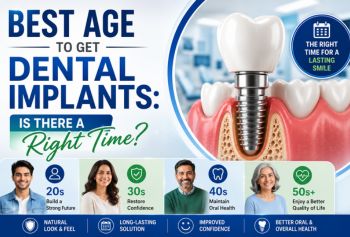
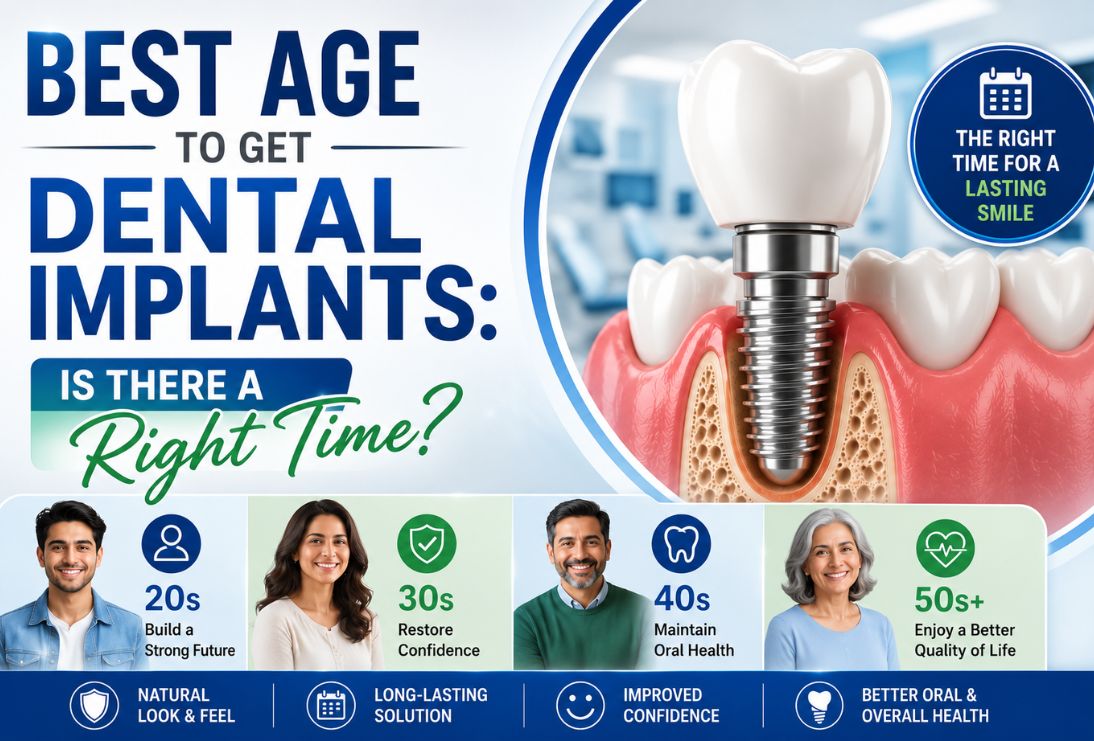
"Am I too old for an implant?" and "Is my child too young?" are two of the most common questions we hear at consultations. The honest answer is that age by itself is rarely the deciding factor. What matters far more is whether the jawbone has finished growing, and whether the patient's overall bone and gum health can support the implant.
Here is how age actually factors into implant candidacy, broken down by life stage.
In This Article
Why Age Comes Up at All
A dental implant is anchored directly into the jawbone, unlike a bridge or denture that sits on top of the gum. That means the jawbone needs to be fully formed before an implant can be placed reliably. This is the one place where age has a genuine, biological effect on implant timing, particularly on the younger end.
Teenagers and Young Adults
Jawbone growth typically continues until the late teens, sometimes into the early 20s, especially in males. Placing an implant before this growth is complete can cause problems, since the implant itself does not move or grow with the surrounding bone the way a natural tooth would. Over time this can leave the implant looking sunken or misaligned compared to neighbouring teeth.
For young patients who lose a tooth before bone growth finishes, dentists usually recommend a temporary option, such as a flipper or a resin-bonded bridge, to hold the space until the jaw is ready for a permanent implant.
Adults in Their 20s to 50s
This is generally considered the most straightforward window for implant treatment. Bone growth is complete, healing capacity is typically strong, and most adults in this range have not yet developed the bone-density or chronic health issues that can complicate treatment later in life. If you are missing a tooth in this age range, earlier treatment is usually better than waiting, since an untreated gap allows the jawbone underneath to gradually resorb.
Older Adults: Is There an Upper Limit?
There is no fixed age cutoff for dental implants. Patients in their 70s and 80s receive implants successfully on a regular basis, provided their overall health supports it. The relevant questions at this stage are about bone density, whether conditions like osteoporosis or diabetes are well managed, and whether the patient can tolerate the minor surgical procedure involved.
In cases where bone has already been lost due to a long-missing tooth, a bone graft can often rebuild enough structure to support an implant. This adds time to treatment but does not rule it out.
What Matters More Than Age
Supports a Good Candidate
- Adequate jawbone density
- Healthy gums, no active infection
- Well-controlled diabetes, if present
- Non-smoker or willing to quit during healing
May Need Extra Steps First
- Significant bone loss (may need grafting)
- Uncontrolled diabetes
- Active gum disease
- Heavy smoking
A thorough dental and medical history review, along with a 3D scan, is the only reliable way to determine candidacy, regardless of how old or young the patient is.
Implant Cost in Kolkata
| Treatment | Cost Range |
|---|---|
| Single tooth implant | Rs 18,000 to Rs 37,000 |
| Bone grafting (per site) | From Rs 6,000 |
| Full mouth implants | Consult for personalised quote |
Frequently Asked Questions
What is the best age to get a dental implant?
There is no single best age. Implants are generally suitable for adults once jawbone growth is complete, typically by the late teens, and remain a good option well into older age as long as the patient is in reasonably good health and has adequate bone density.
Can teenagers get dental implants?
Implants are usually not placed in teenagers because the jawbone is still growing. Placing an implant before bone growth finishes can result in the implant becoming misaligned as the jaw continues to develop. Dentists typically wait until growth is complete, often around 18 to 21 years.
Is there an upper age limit for dental implants?
There is no strict upper age limit. Implants have been placed successfully in patients in their 70s, 80s, and beyond. The deciding factors are bone density, gum health, and the ability to heal, not age on its own.
Does age affect implant healing time?
Healing can be slightly slower in older patients, particularly those with conditions like osteoporosis or diabetes, but it does not stop successful integration. Most healthy adults of any age heal within the typical 3 to 6 month window.
What matters more than age when considering an implant?
Bone density, gum health, control of conditions like diabetes, and smoking status matter far more than chronological age in determining whether someone is a good implant candidate.
Wondering If You're a Good Candidate?
Book a consultation at Teeth Care Multispeciality Dental Clinic. A simple scan and review of your dental and medical history will tell you exactly where you stand, at any age.
WhatsApp Us Call: 9831526251